The Villa dei Capolavori holds the most important collection of works by Giorgio Morandi (1890–1964). There are fifty of them: seventeen oil paintings, five watercolours, eight drawings and twenty etchings. Two things set it apart: it is complete, covering every subject, technique and period of the painter’s career, from the 1918 Metaphysical Still Life to the watercolours of 1963; and it was built together with the artist, by Luigi Magnani, over more than twenty years of friendship. It hangs on the first floor of the Villa, in Mamiano di Traversetolo near Parma, and is included in the standard admission ticket.
A friendship in fifty works
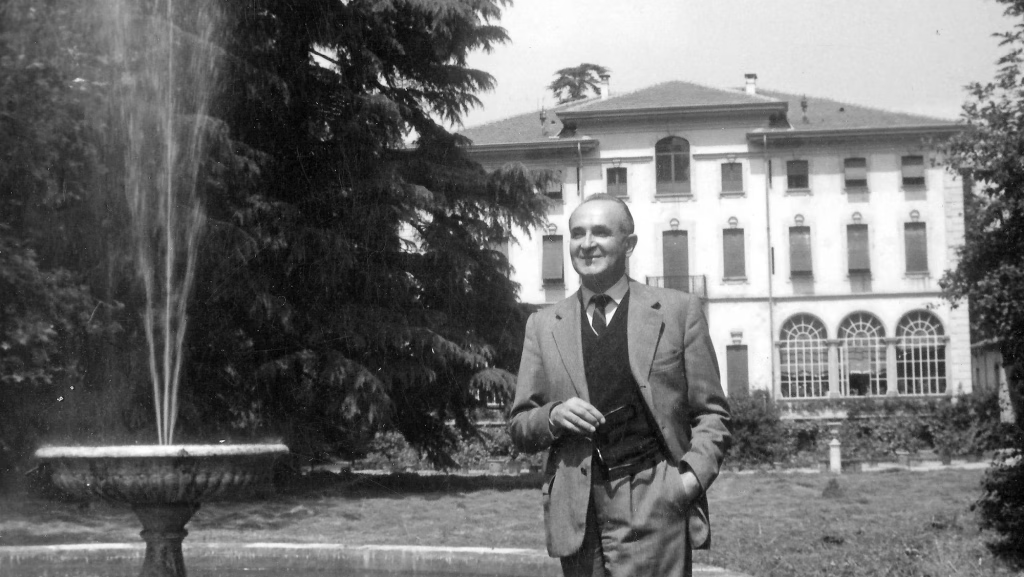
Morandi sold little, and he chose his buyers. Magnani was one of the very few collectors who bought directly from him. They met on 10 October 1940, when the critic Cesare Brandi asked Magnani to take Morandi, who was taking the waters at Salsomaggiore, to Parma to see Correggio’s Camera di San Paolo, and then to Colorno, where Glauco Lombardi kept his Corots and Daubignys. Magnani was thirty-four, Morandi fifty.
Twenty years later, on 5 June 1960, an amateur film camera caught them together with Francesco Arcangeli, the Bolognese art historian who wrote a monograph on Morandi. The footage, kept by the Foundation, is silent and lasts less than a minute: it is one of the very few records of Morandi and Magnani together.
After that first meeting Morandi gave him three etchings. Two of them were flowers: Flowers in a Small White Vase of 1928 and Zinnias in a Vase of 1932. Morandi offered flowers to friends the way a guest brings a bouquet; Brandi wrote that for him, giving away a picture was like breaking bread, because he felt he was parting with a piece of himself.
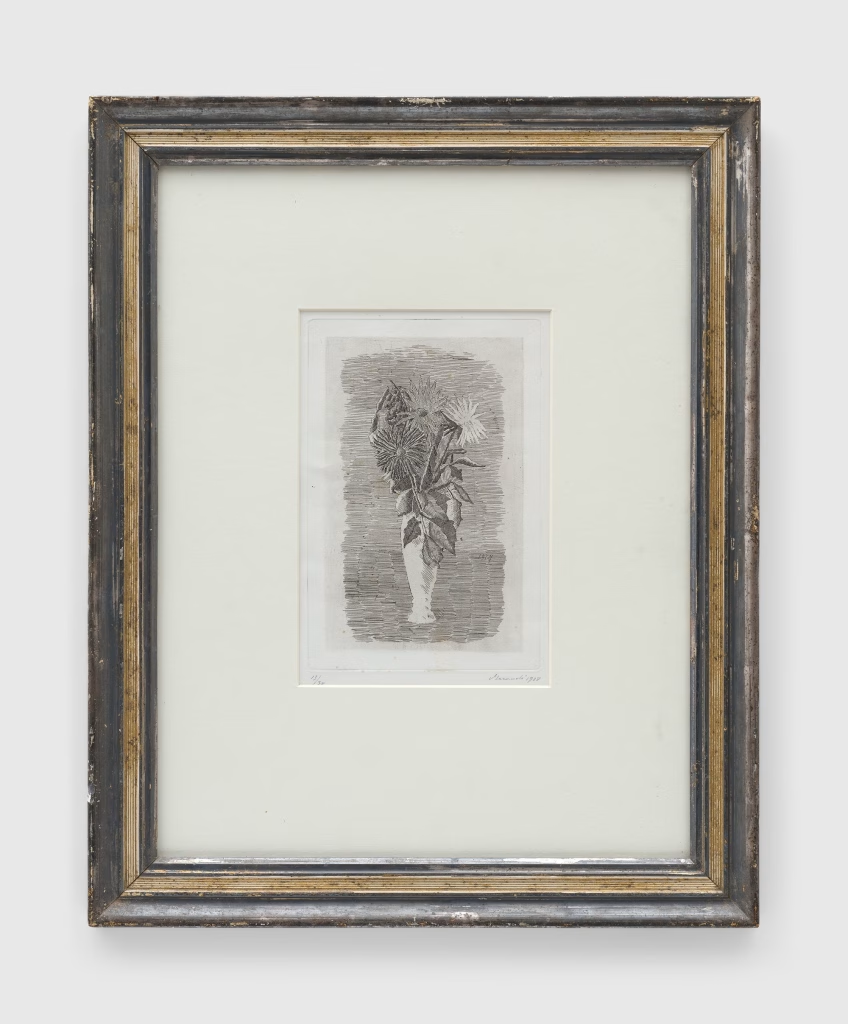
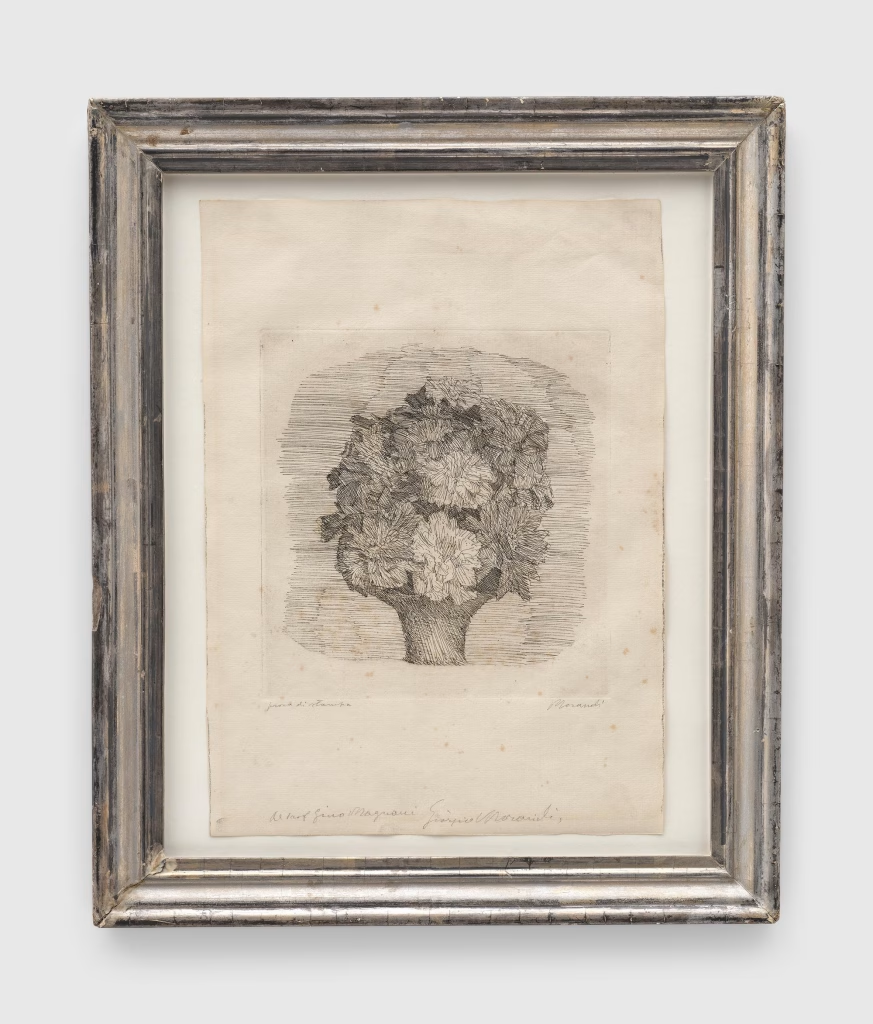
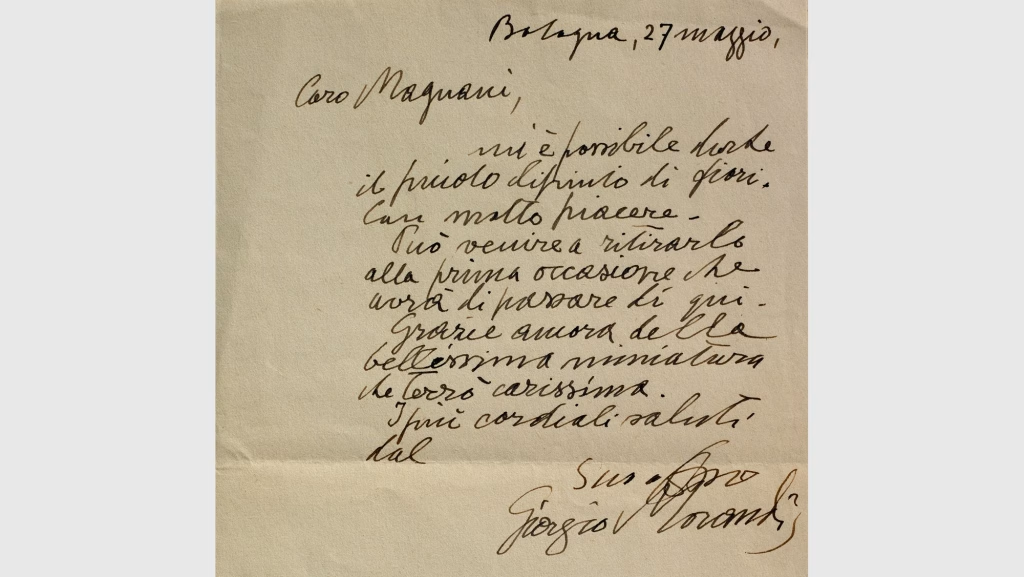
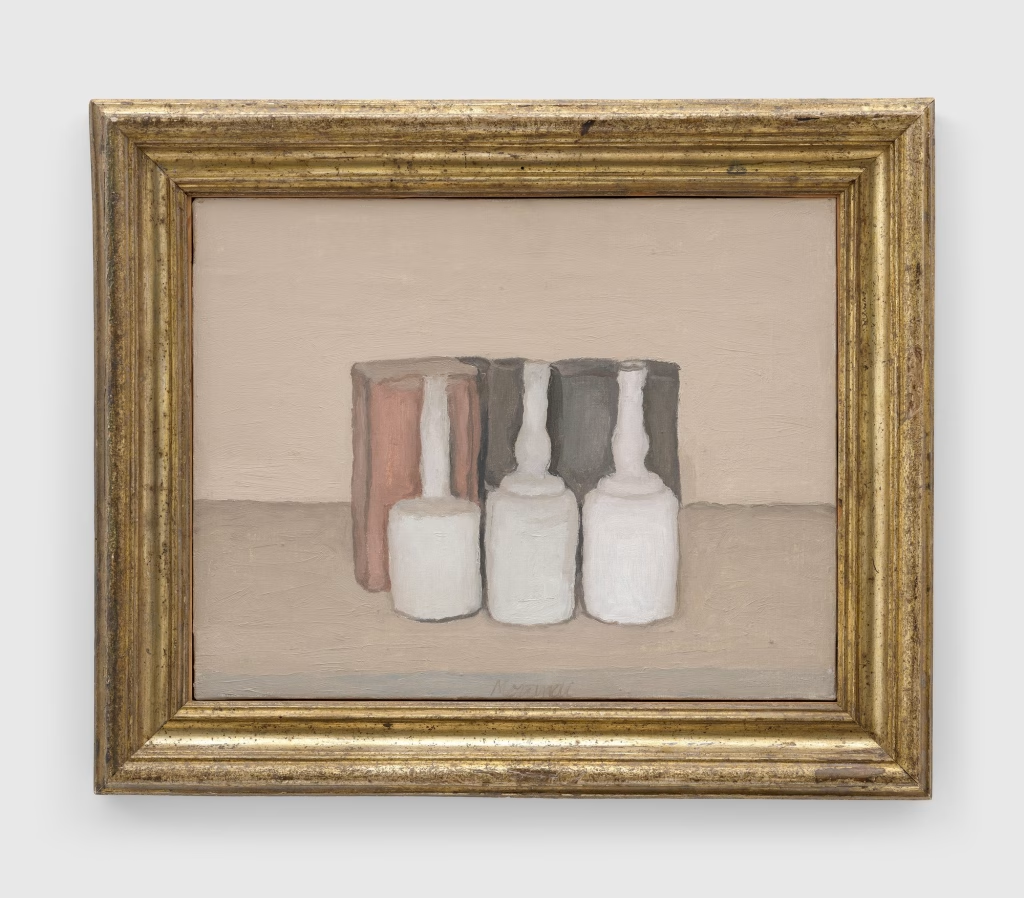
Then came the visits. At Christmas or Easter Morandi would arrive in Mamiano with a new canvas and leave with produce from the Magnani farms and the odd page from an illuminated manuscript. He advised his friend on where to hang the pictures in the villa. On 10 April 1954, while Magnani was convalescing, he wrote that he was glad Magnani liked the painting with the three white bottles: Magnani owed him nothing, he wanted to give it to him.
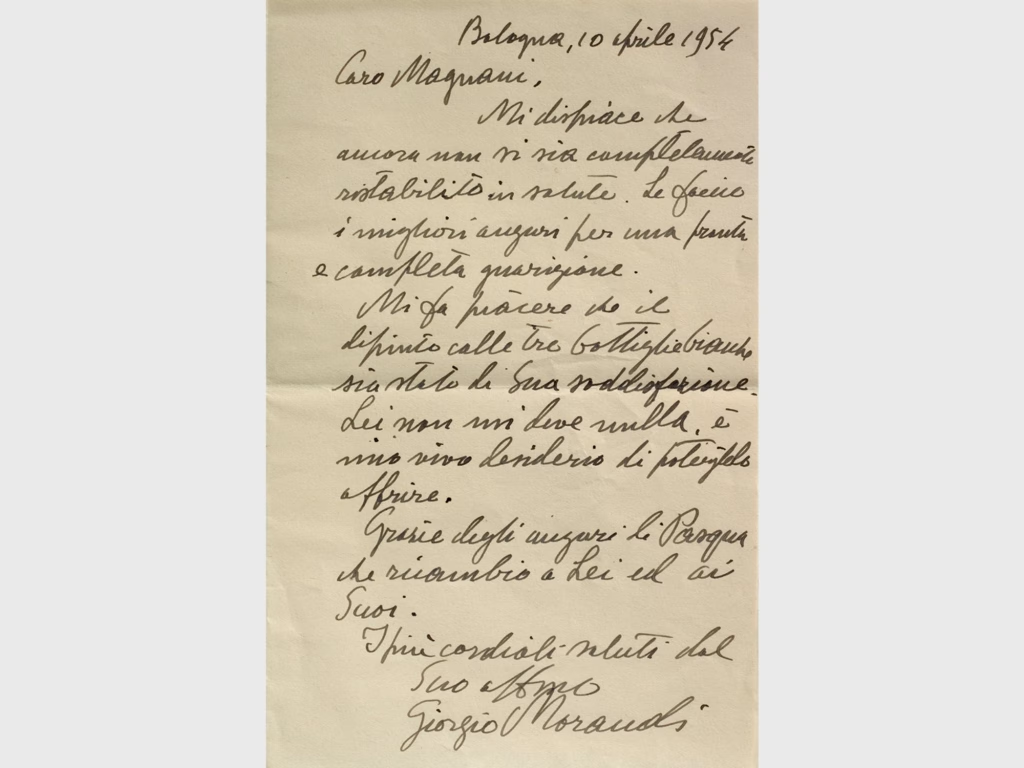
Magnani completed the group with purchases at auction and from other collectors, also after the painter’s death, looking for the works the collection still lacked. He told the whole story in 1982 in Il mio Morandi (“My Morandi”), which also publishes the painter’s letters from 1942 to 1964.

The commissioned painting
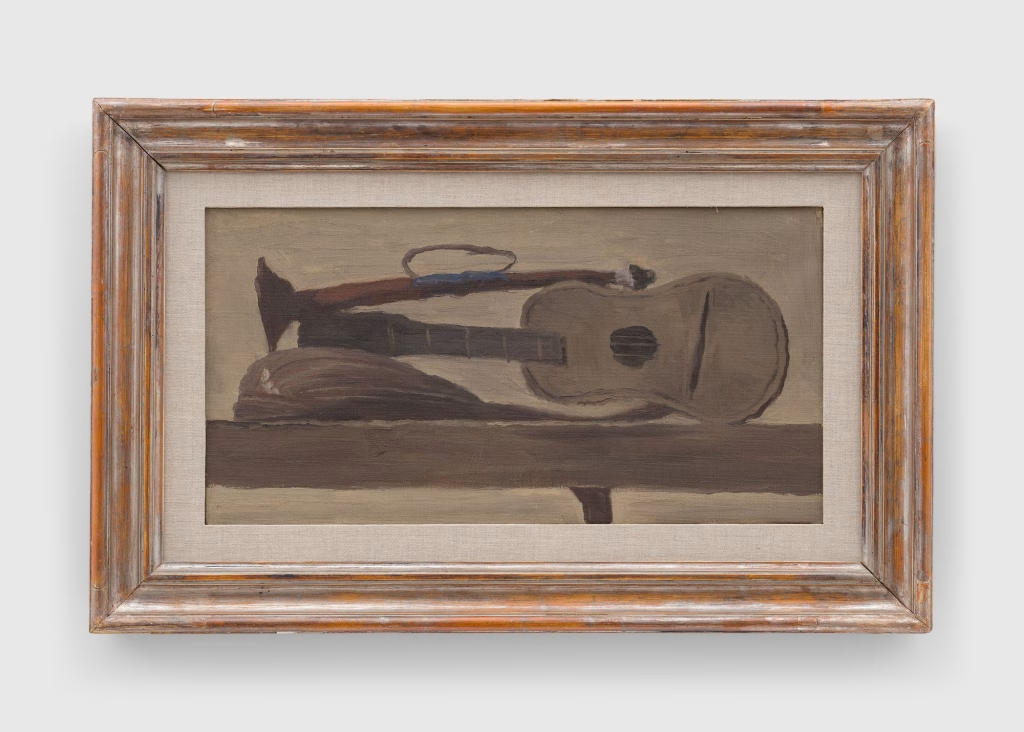
A few weeks after they met, Magnani asked Morandi for a painting of musical instruments, unaware that Morandi did not work to commission. The painter’s only objection was that he had nothing to paint from, so Magnani brought him an antique Venetian lute, two Indian flutes and other precious instruments lent by a friend. Morandi looked at them for a long time in silence, then sent them back:
“You see… these are precious things… they could fall, they could break… you understand… please, take them well away.”
In 1941 he painted a toy trumpet, a flea-market guitar and an old mandolin instead. Still Life (Musical Instruments) is the only time Morandi painted objects from outside his own world, and very probably the only picture he ever agreed to paint on request. Only later did Magnani understand what he had asked of the painter: to step outside his own idea of a painting and work with things that had no place in his history.
The works, from 1912 to 1963
The collection reads like a biography. These are the works to look for, in the order Morandi made them.
Early years and Metaphysical painting
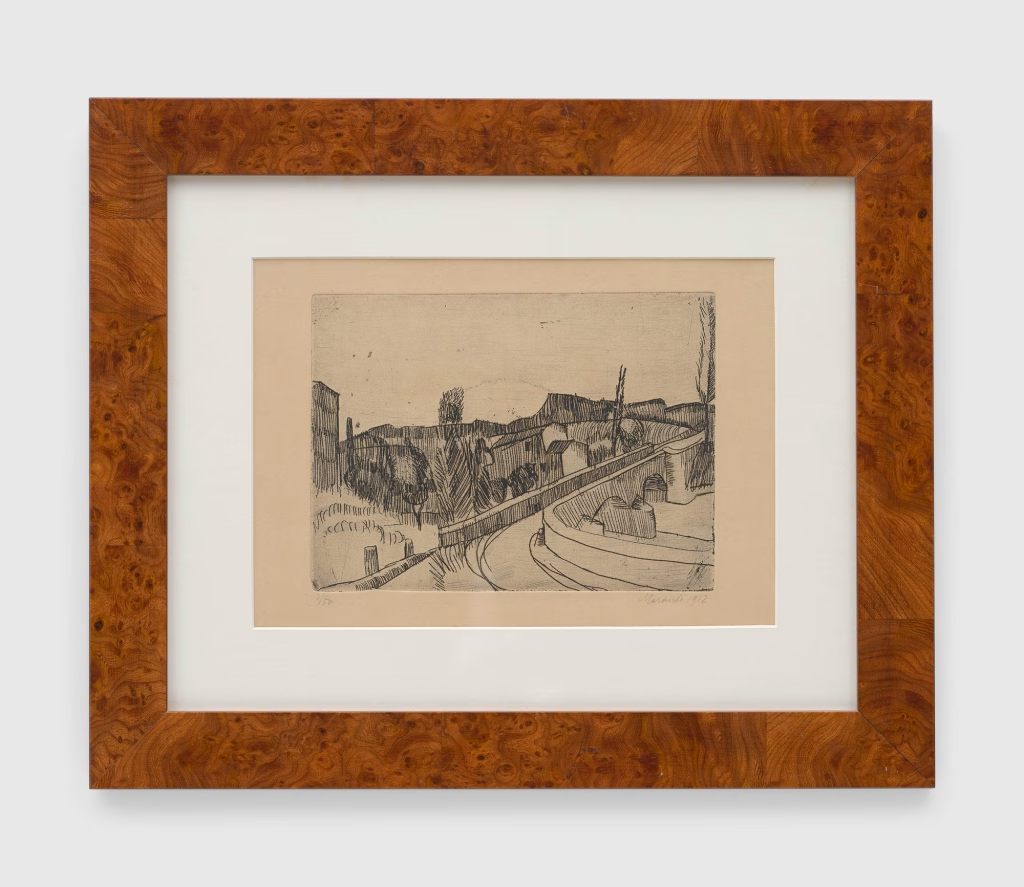
The Bridge over the Savena in Bologna, 1912, is one of Morandi’s first known etchings, a tribute to Cézanne, Giotto and Vitale da Bologna. The plate shows marks that were not made with the needle: Morandi let powdered sulphur sit on the zinc, biting the metal and giving a wash-like tone. It was the only time he used the process.
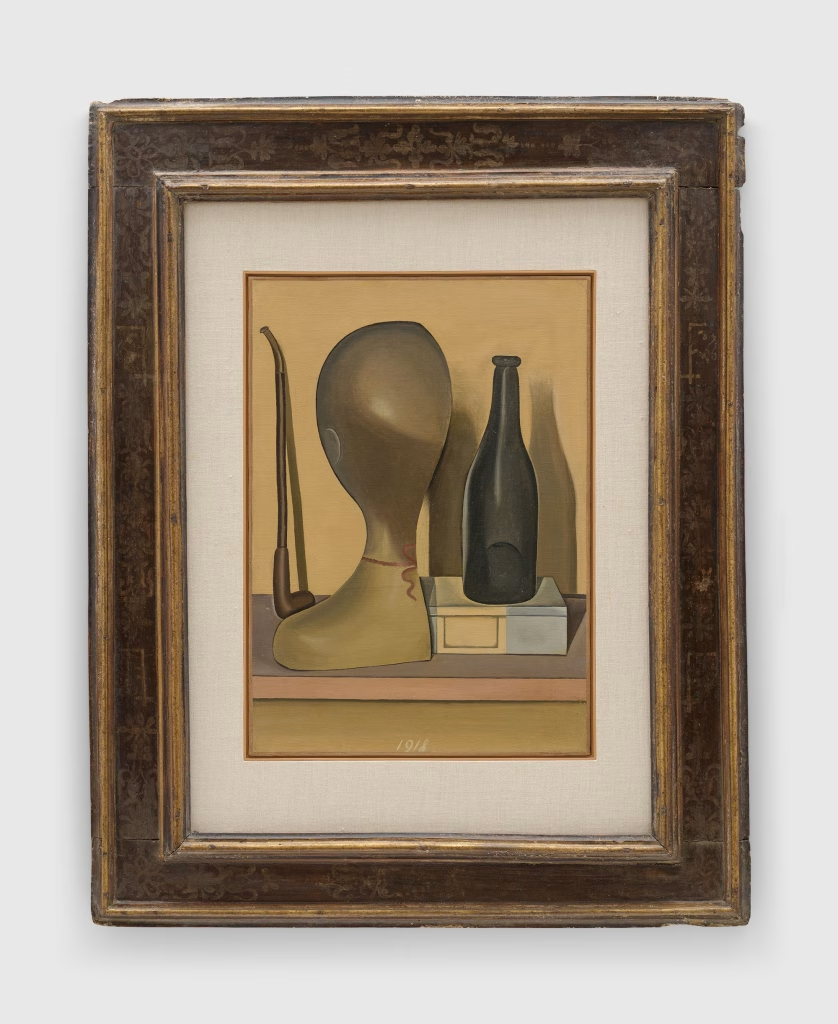
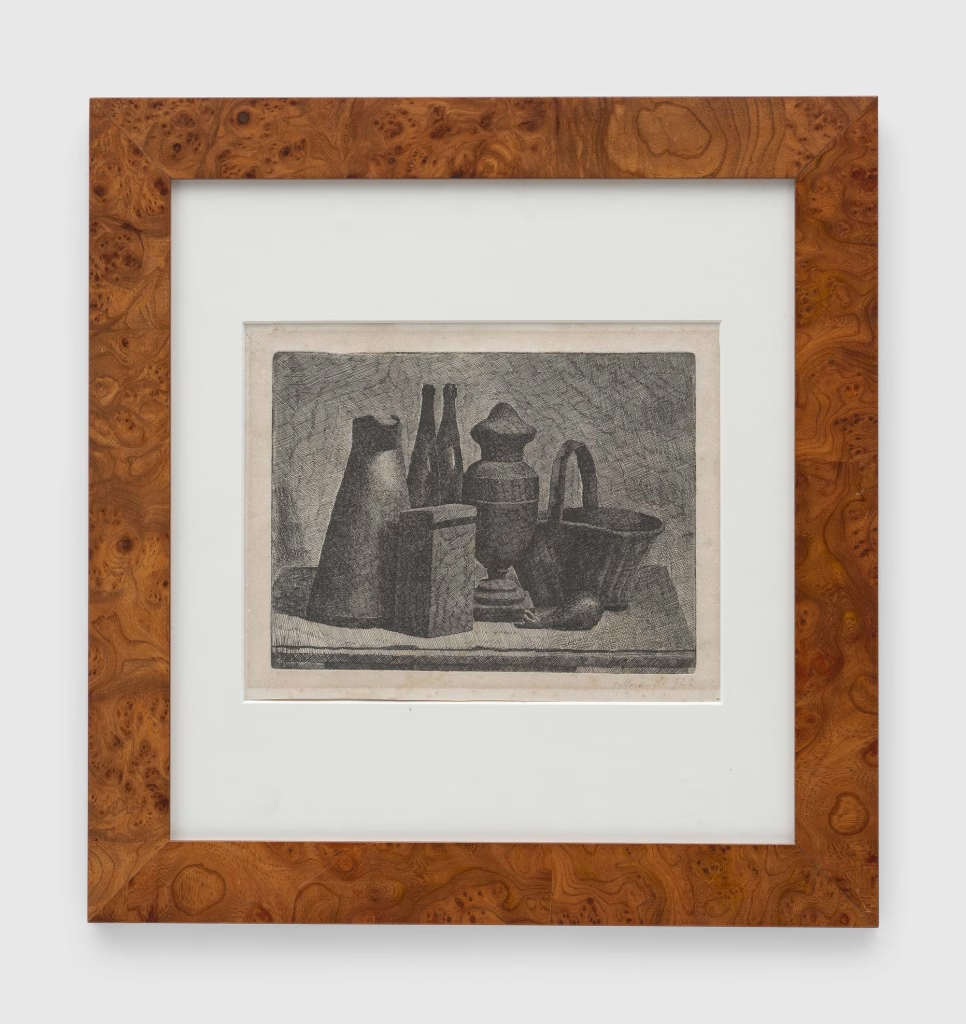
The Metaphysical Still Life of 1918 belongs to the brief period when Morandi wrote for Valori Plastici alongside Carrà and de Chirico. It is closer to the stillness of Piero della Francesca than to de Chirico’s dreams. Three years later, Still Life with Bread Basket, a plate from the artist’s own archive, already marks his farewell to Metaphysical painting: full volumes, light built from line.
A face and a basket of fruit
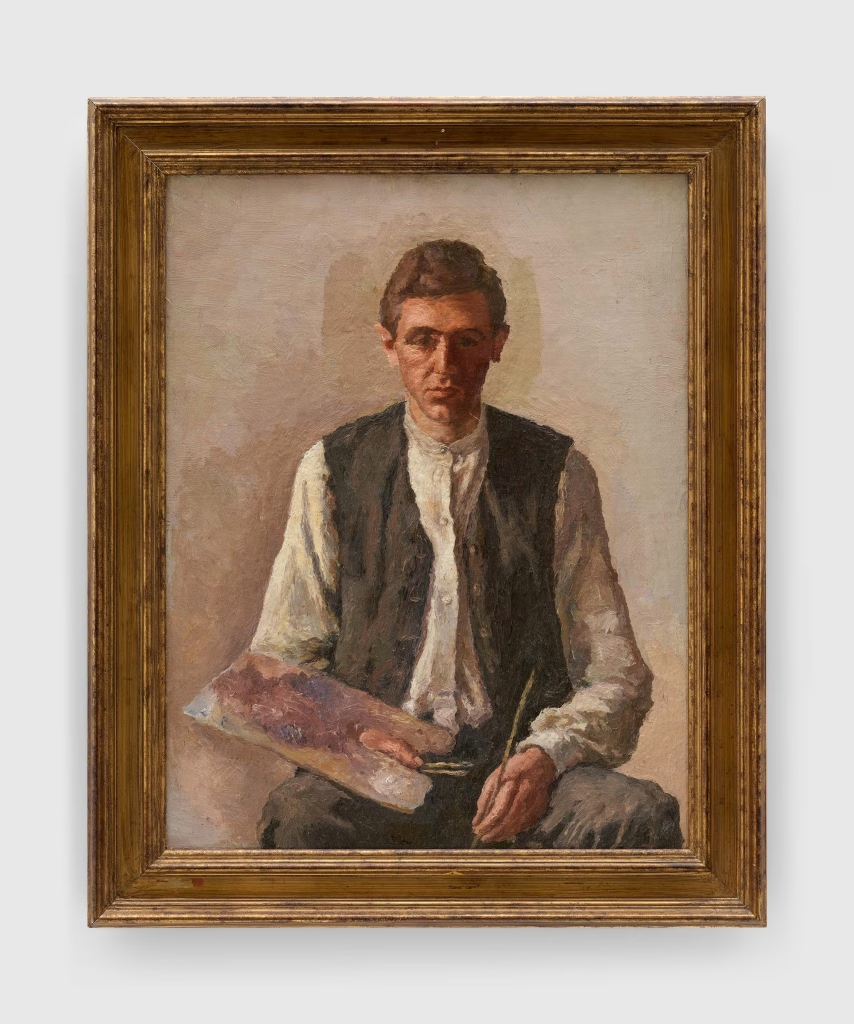
Morandi painted himself only seven times. Magnani bought the 1925 Self-Portrait, built up in volumes like a Cézanne, from the Milanese collector Gianni Mattioli after the painter’s death. He wrote that in front of the mirror Morandi felt hemmed in by the facts of his own face, which kept him from transforming reality.
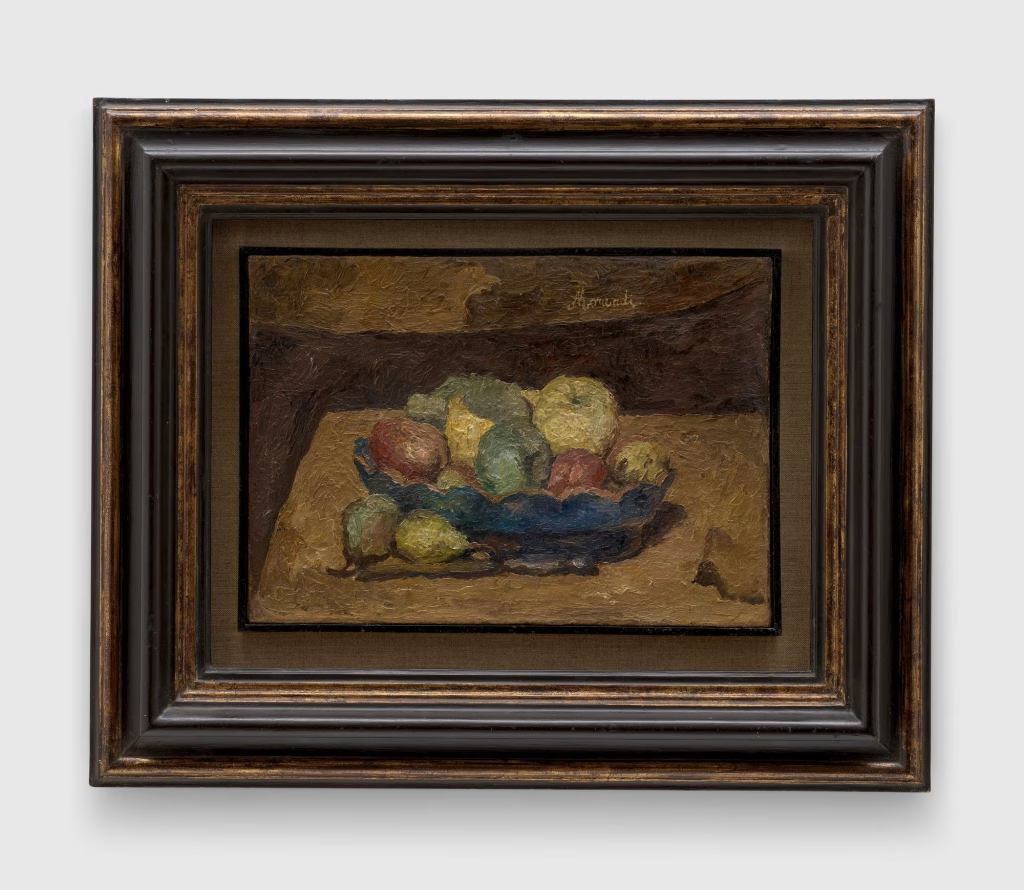
Still Life with Fruit, 1927, is an unusual picture: the paint is thick, almost in relief, and after this canvas and a few etchings of the same year the fruit basket vanishes from Morandi’s repertoire for good. It is another tribute to Cézanne, with the substance of Chardin.
The same objects, again and again
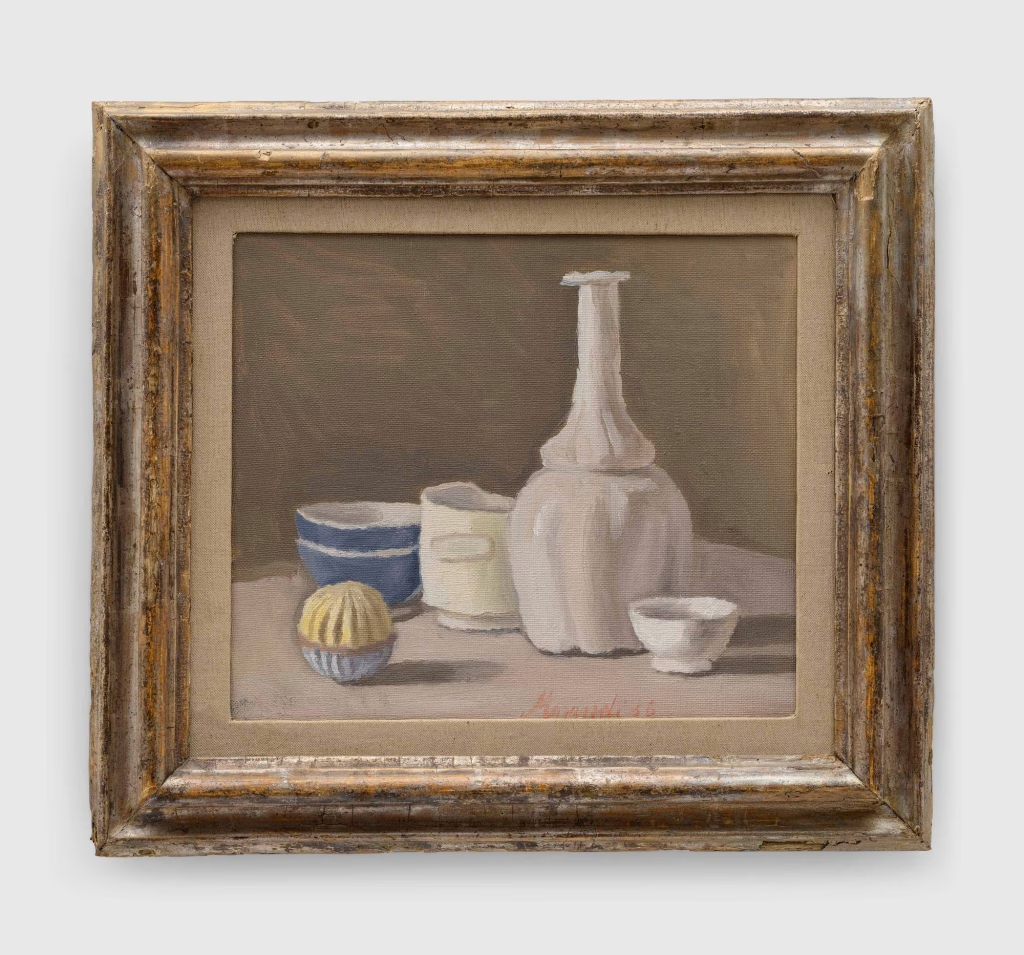
The 1936 Still Life opens a long series built from the same few objects: two blue bowls, two white vessels, a white vase, a sugar bowl and a toy ball. Morandi moved them, rearranged them and painted them again to study their forms and shadows. The yellows and blues come from Chardin and Vermeer, his idols at the time. In 2013 BOZAR in Brussels chose this very picture as the image of its major Morandi retrospective.
The war years
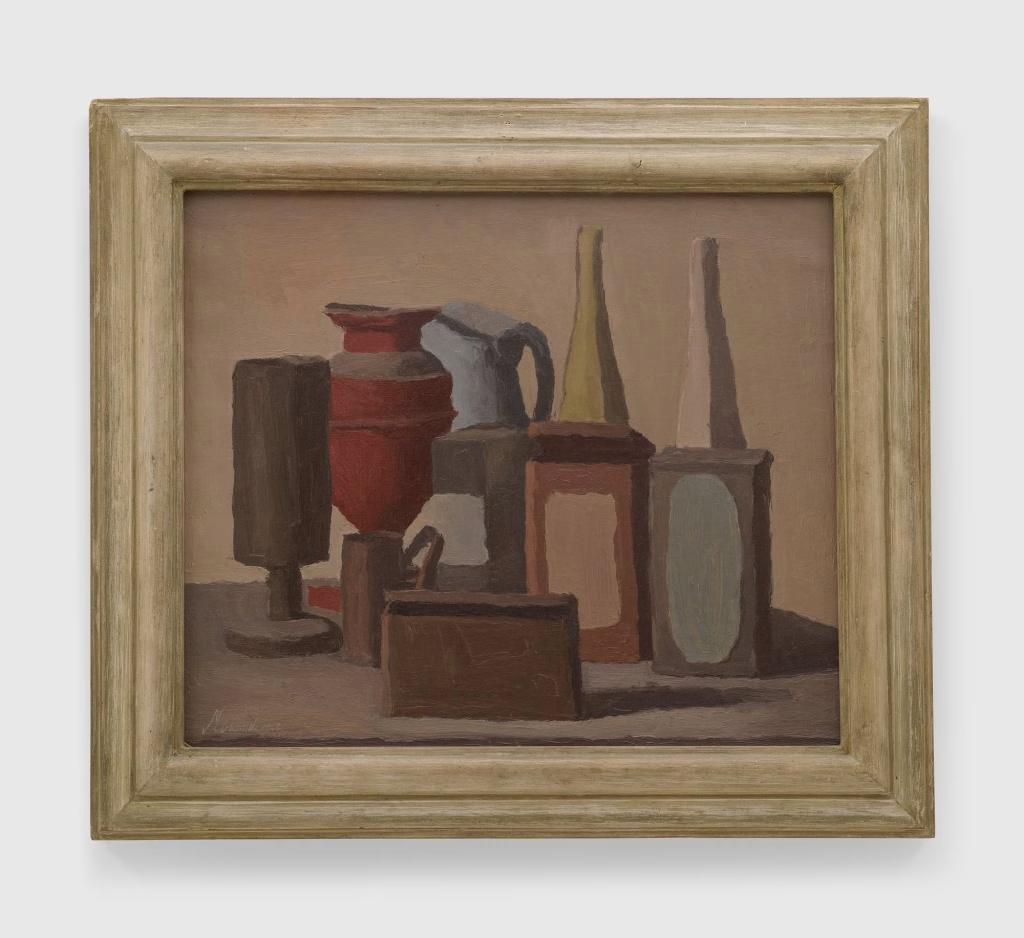
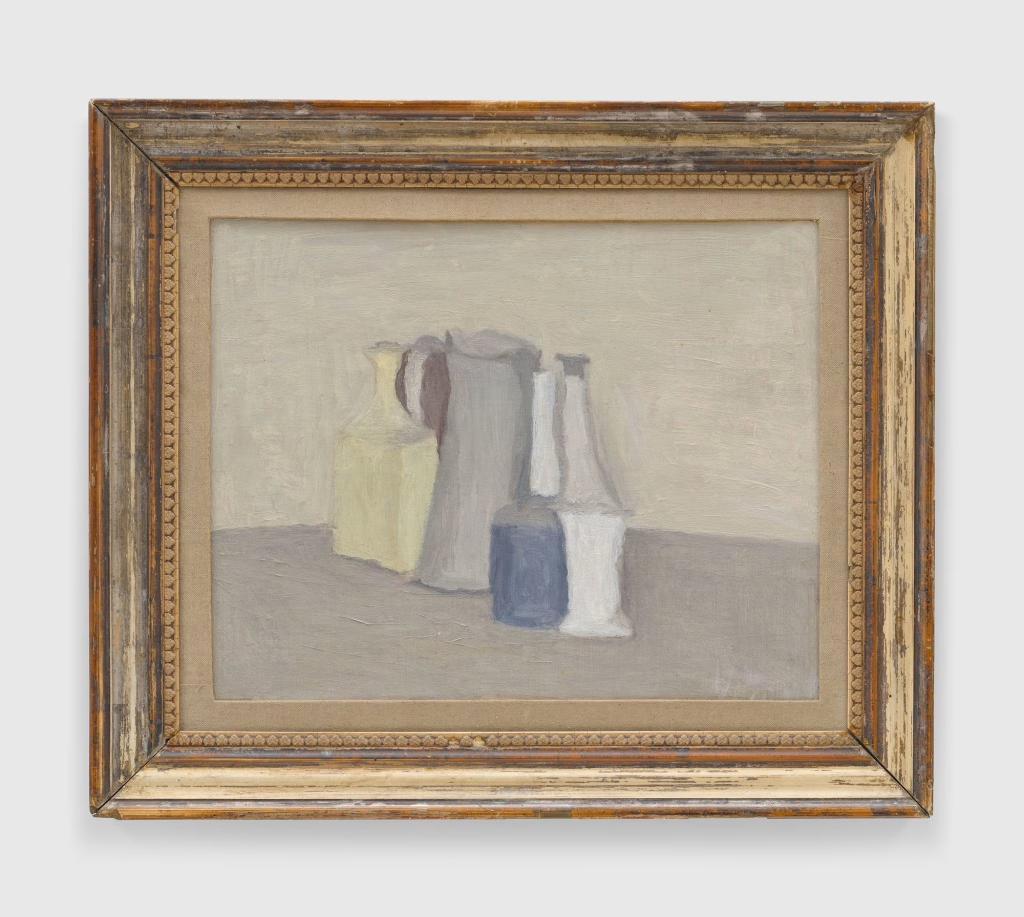
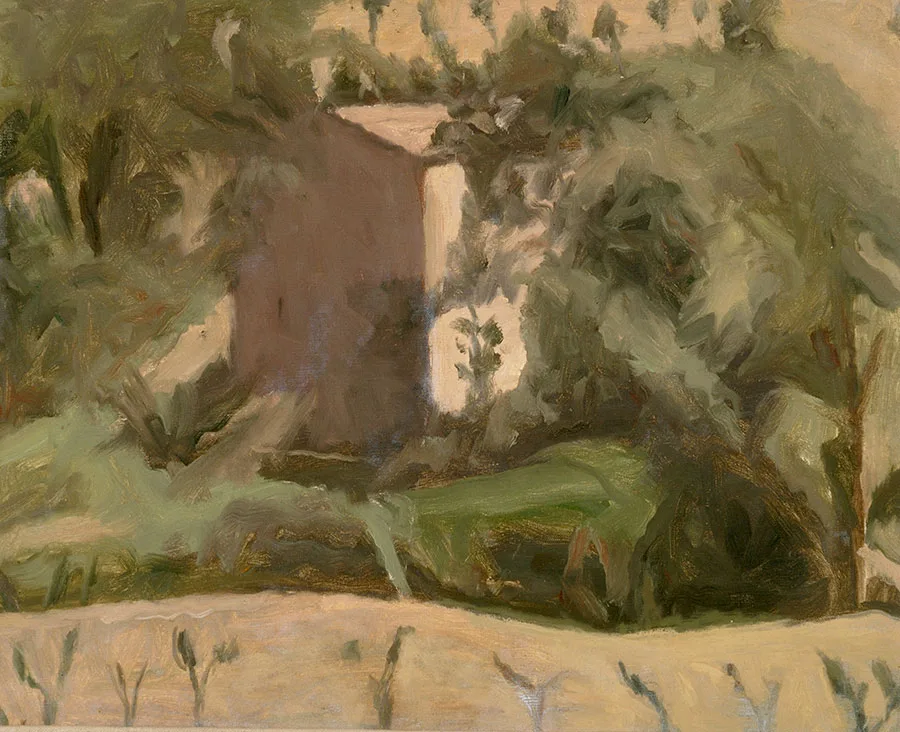
The two still lifes of 1942 have a darker, more contrasted palette than those painted before and after the war. The objects are pushed towards the edge of the canvas, unsteady, like the time in which they were made. In 1943 Morandi took refuge in Grizzana: the Landscape of that year shows the Apennines that were to him what Mont Sainte-Victoire had been to Cézanne.
After the war: working in series
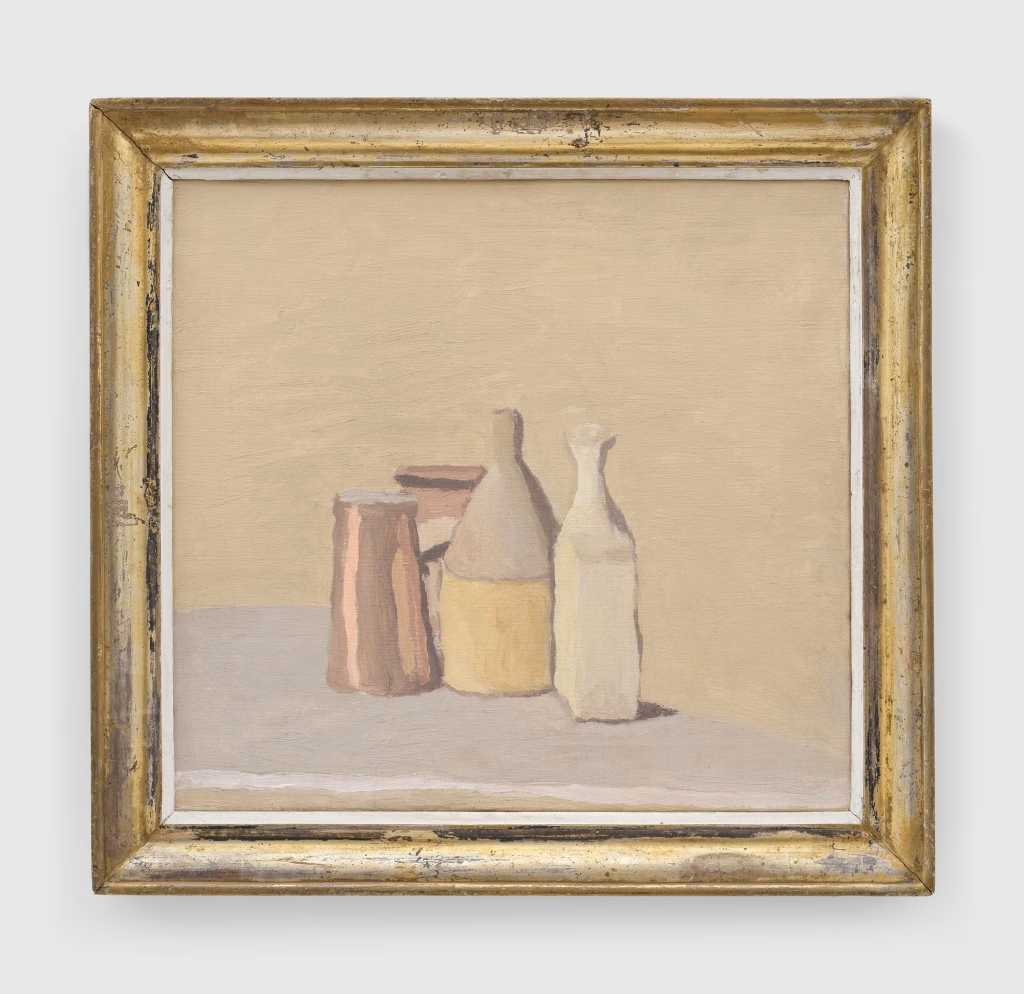
From 1948 until his death Morandi painted more than half of all his pictures, working almost exclusively in series. In the still lifes of 1948 and 1953 the objects huddle at the centre of the canvas in compact, symmetrical groups, defined less and less by drawing and more and more by colour.
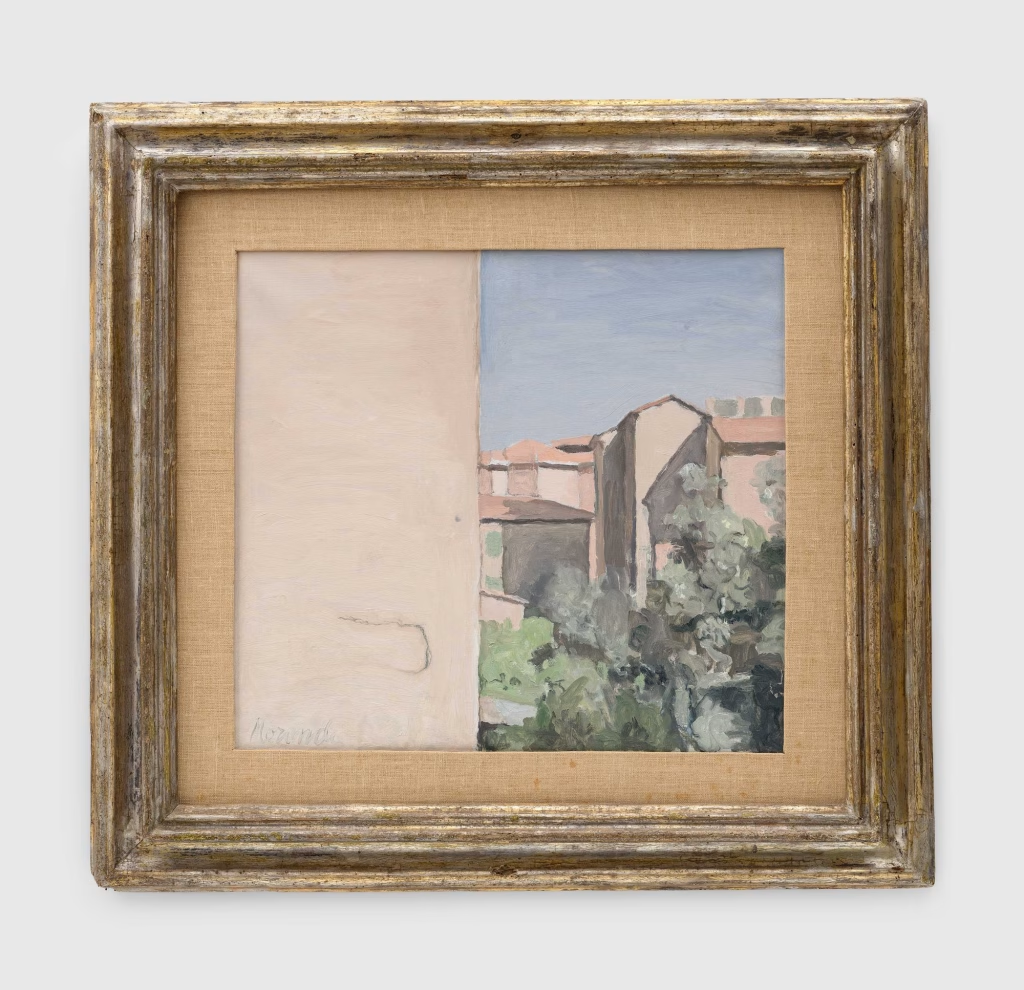
The Courtyard in Via Fondazza, 1954, is the view from the window of his Bologna studio. A pale wall takes up almost the whole left half of the picture; it is there to light up the other half, where the landscape turns rich in colour. Morandi was coming back to landscape after almost ten years, and he built it like a still life.
The last years
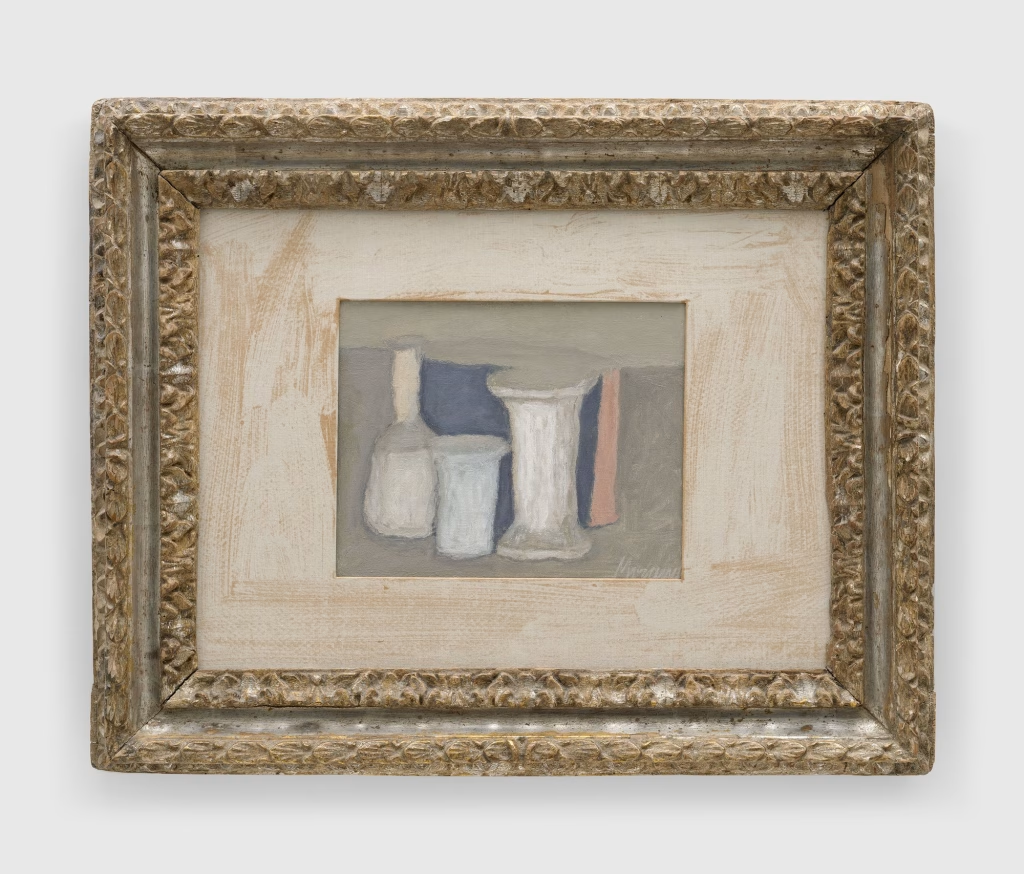
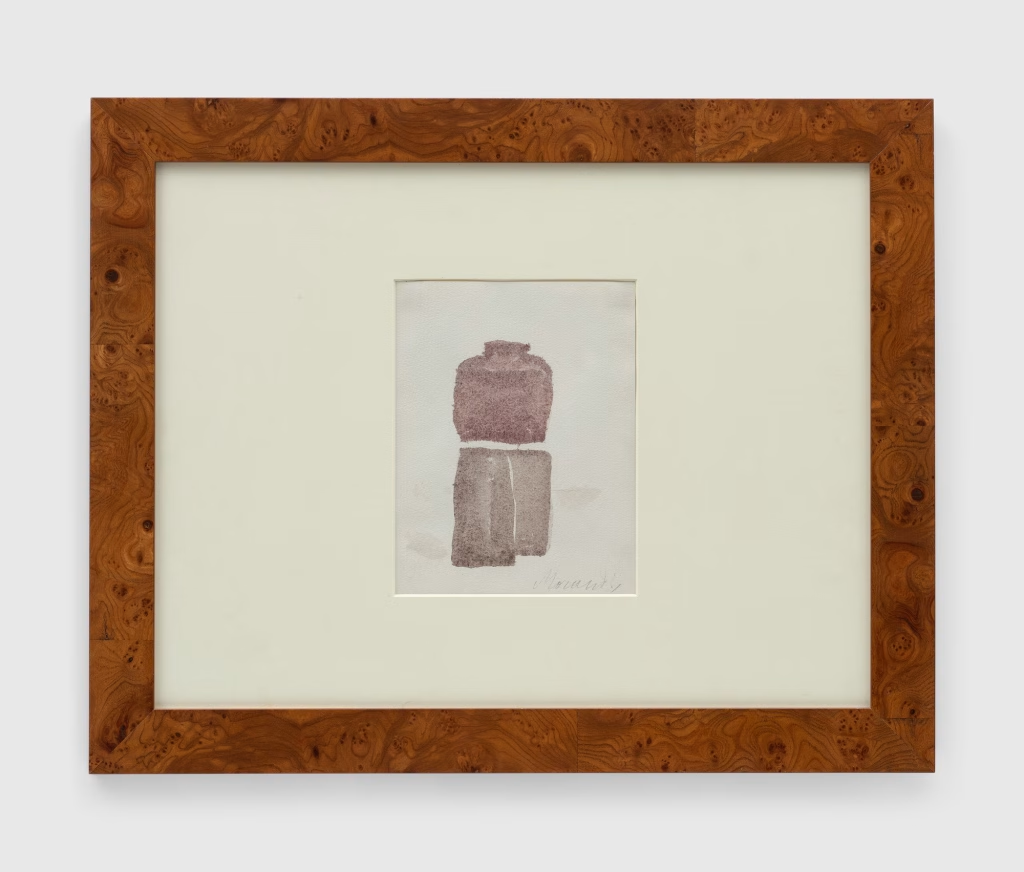
The two still lifes of 1963, one in oil and one in watercolour, are among Morandi’s last works. Outlines dissolve, the viewpoint shifts, and blues, purples and salmon pinks appear. Some thought them unfinished; they are finished pictures that chase a fleeting perception and bring to mind the colour fields of Mark Rothko.
Works mentioned on this page
| Year | Work | Medium | Size (cm) |
|---|---|---|---|
| 1912 | The Bridge over the Savena in Bologna | etching on zinc | 16.6 x 22.2 |
| 1918 | Metaphysical Still Life | oil on canvas | 54 x 38 |
| 1921 | Still Life with Bread Basket (Large Plate) | etching on zinc | — |
| 1925 | Self-Portrait | oil on canvas | 61 x 47.5 |
| 1927 | Still Life with Fruit | oil on canvas | 27 x 38.5 |
| 1928 | Flowers in a Small White Vase | etching | 16.3 x 24.6 |
| 1932 | Zinnias in a Vase | etching on zinc | 19.4 x 20.3 |
| 1936 | Still Life | oil on canvas | 32 x 37 |
| 1941 | Still Life (Musical Instruments) | oil on canvas | 27 x 52.5 |
| 1942 | Still Life | oil on canvas | 36 x 42 |
| 1942 | Still Life | oil on canvas | 37 x 46 |
| 1943 | Landscape | oil on canvas | 40 x 51 |
| 1948 | Still Life | oil on canvas | 44 x 48 |
| 1953 | Still Life | oil on canvas | 35.5 x 45.5 |
| 1954 | The Courtyard in Via Fondazza | oil on canvas | 48 x 53 |
| 1963 | Still Life | oil on canvas | 20.5 x 25.8 |
| 1963 | Still Life | watercolour on paper | 20.5 x 16 |
Morandi and Cézanne
Magnani said more than once that of all the artists in his collection he loved two above the rest: Morandi and Cézanne, ahead even of Titian and Monet. In both he saw an artisan of his own art, working with the care and slow pace of the old masters, one eye on them and the other on nature. The Villa also holds watercolours by Cézanne and his Still Life with Cherries, and the kinship shows from room to room.
Where to see Morandi
In Bologna, the Museo Morandi holds the largest public collection of his work, and Casa Morandi in Via Fondazza is the house where he lived and painted. In the Apennines, Grizzana Morandi keeps the house where he spent his summers. The Villa dei Capolavori holds the most important collection: fifty works chosen together with the painter, hanging in the rooms where the collector lived, alongside Titian, Goya and Cézanne.
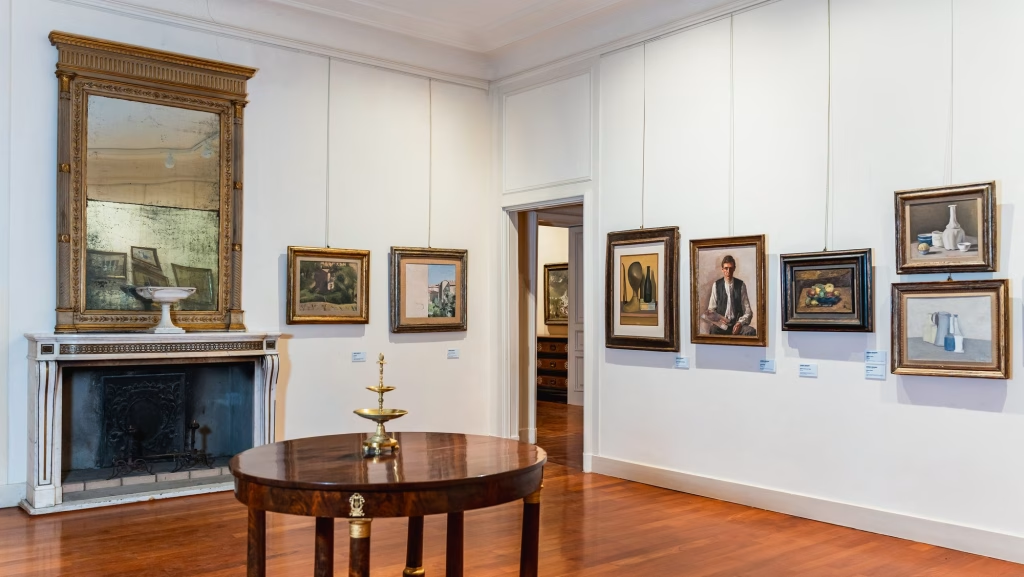
The Villa’s Morandi collection often travels. It has been shown at the Musée de Grenoble in 2021, at the Estorick Collection in London in 2023 and at David Zwirner in New York in 2025, in Giorgio Morandi: Masterpieces from the Magnani-Rocca Foundation, curated by Alice Ensabella: one of the largest Morandi exhibitions in New York since the Metropolitan Museum’s retrospective of 2008.
Visiting
- Where: first floor of the Villa dei Capolavori, via Fondazione Magnani-Rocca 4, Mamiano di Traversetolo (Parma), Italy. How to get here
- Tickets: the Morandi works are part of the permanent collection, included in the admission ticket together with the current exhibition and the Romantic Park. Full price €15, bought on arrival, no booking needed. Opening hours and tickets
- When: the Villa is open from March to mid-December; in 2026 until 13 December. Closed on Mondays.
By Stefano Roffi, Scientific Director of the Magnani-Rocca Foundation