The exhibition ended on 15 December 2024.
In short. Surrealism was born on 15 October 1924 with André Breton’s Manifeste du Surréalisme. It reached Italy first through de Chirico and Savinio, on their return from Paris in the 1930s, and then split into two tendencies: a group in dialogue with the French, with Enrico Baj and Sergio Dangelo, and a fantastic figurative strand, with Leonor Fini, Fabrizio Clerici and Stanislao Lepri. In 2024 the exhibition “Surrealism and Italy” (Il Surrealismo e l’Italia) brought together more than 150 works at the Villa dei Capolavori, from Dalí, Magritte and Man Ray to the Italians.
Now at the Villa dei Capolavori: Man Ray: tutto, until 13 December 2026. The permanent collection and the Romantic Park can be visited throughout the opening season: opening hours and tickets.
WHERE
Magnani-Rocca Foundation,
via Fondazione Magnani Rocca 4,
Mamiano di Traversetolo (Parma).
Google Maps
WHEN
14 September ― 15 December 2024
Also open on 1 November and 8 December.
OPENING HOURS
Tuesday to Friday, continuous 10:00–18:00 (ticket office closes at 17:00) – Saturdays, Sundays and public holidays, continuous 10:00–19:00 (ticket office closes at 18:00). Closed on Mondays.
PRICES
€15.00, also valid for the permanent collections
€13.00 for groups of at least fifteen people
€5.00 for schools
INFORMATION AND GROUP BOOKINGS
Tel. +39 0521 848327 / 848148 [email protected]
On Saturdays at 16:00 and on Sundays and public holidays at 11:30, 15:30 and 16:30, there is a visit to the exhibition with a specialist guide; you can book at [email protected], or come to the museum entrance until places run out; cost €20.00 (admission and guide).
RESTAURANT
Tel. +39 0521 1627509
WhatsApp +39 393 7685543
e-mail [email protected]
PARTNERS
The exhibition was made possible thanks to

Media partners: Gazzetta di Parma, Kreativehouse.
With the collaboration of: Angeli Cornici, Bstrò, Cavazzoni Associati, Società per la Mobilità e il Trasporto Pubblico.
14 September – 15 December 2024
Magnani-Rocca Foundation, Mamiano di Traversetolo – Parma
A hundred years ago Surrealism was born, and from that moment the perception of the world would never be the same. With the Manifeste du Surréalisme, published on 15 October 1924 and marking the start of the movement, Breton declares that imagination is nothing other than the revelation of what we are, of our very substance, which is dream, purity, energy, freedom.
And so, in the Villa dei Capolavori, home of the Magnani-Rocca Foundation at Mamiano di Traversetolo near Parma, a few steps from the rooms housing major works by Renoir, Monet, Cézanne, Titian, Dürer, Van Dyck, Goya, Canova, Morandi, Burri and many others, from 14 September to 15 December 2024 one of the most decisive and long-lived avant-gardes of the twentieth century – Surrealism – is celebrated on the centenary of its origin, also presenting its complex relationship with Italian artists and the Italian cultural scene from the late 1920s to the late 1960s.
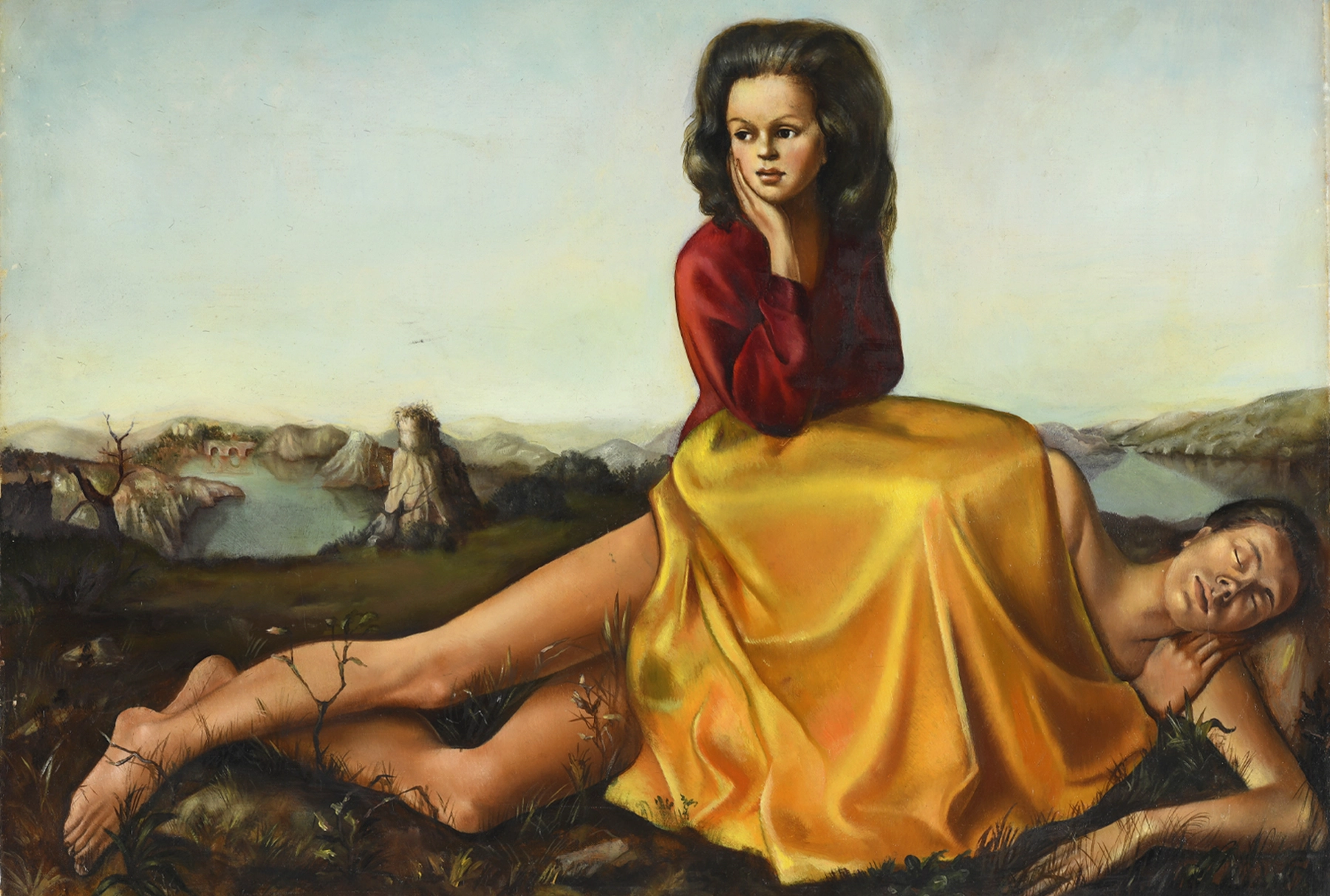
The major exhibition “Surrealism and Italy” (Il Surrealismo e l’Italia), curated by Alice Ensabella, Alessandro Nigro and Stefano Roffi, through more than 150 works by Salvador Dalí, René Magritte, Max Ernst (page in Italian), Joan Miró, Marcel Duchamp, Man Ray, Yves Tanguy, Giorgio de Chirico and his brother Alberto Savinio, Enrico Baj, Fabrizio Clerici, Leonor Fini and other protagonists of this imaginative current, bears witness to the breadth of means and languages of Surrealism and explores its impact and evolution in our country, offering a new and fascinating perspective on a movement that left an indelible mark on the contemporary artistic imagination.
The exhibition unfolds in two main chapters, divided into thematic sections.


International Surrealism and its arrival in Italy
The first chapter aims to present international Surrealism and its arrival in Italy: mediated at first by the work of de Chirico and Savinio on their return from Paris in the 1930s, then represented through the works of the masters of the historic movement, which show a profound aesthetic and formal heterogeneity (abstract and figurative art) as well as a multitude of media (painting, collage, assemblage, photography, ready-made, objets trouvés). Important works by Magritte, Dalí, Man Ray, Ernst, Masson, Miró, Tanguy, Duchamp, Matta and Lam are presented here, in addition to de Chirico.
The Italian Surrealist scene
The second chapter identifies the protagonists of the Italian Surrealist scene, from the 1930s onwards, in order to examine its points of contact with the French group, but also – and above all – to bring out its independence and originality.


In Italy two main tendencies can be seen taking shape: on the one hand, the birth of a group inspired by new artistic practices and in contact with the French group, as can be seen in the works of Sergio Dangelo or Enrico Baj. On the other, a fantastic figurative strand, characterised by the production of visionary works, to which belong, among others, Leonor Fini, Fabrizio Clerici and Stanislao Lepri, for whom the work of de Chirico and Savinio was fundamental. The latter attracted international critics, as shown by their presence in the monographic issue of the American magazine View, published in 1946 and entitled Italian Surrealists.


Finally, particular attention is given to the context in which Surrealism spread in Italy, highlighting the figures and places that made it happen, in particular gallerists (Schwarz, Tazzoli, Cardazzo, Del Corso, Jolas, Sargentini, Brin, etc.) and collectors (Guggenheim, Passaré, etc.).
The Magnani-Rocca Foundation thus invites the public on this fascinating journey, discovering how the Surrealist movement freed the unconscious and transformed the perception of reality, offering new keys for understanding art and life. A celebration that is not only a tribute but a living and current reflection on how psychic automatism continues to influence our present and, quoting Breton once again, to discover that “The marvellous is always beautiful; indeed, only the marvellous is beautiful.”
SURREALISM AND ITALY EXHIBITION
Magnani-Rocca Foundation, via Fondazione Magnani-Rocca 4, Mamiano di Traversetolo (Parma).
Exhibition and catalogue curated by Alice Ensabella of Université Grenoble Alpes, Alessandro Nigro of the University of Florence, and Stefano Roffi, scientific director of the Magnani-Rocca Foundation.
Catalogue (Dario Cimorelli Editore) with essays by the curators and by Silvana Annicchiarico, Mauro Carrera, Walter Guadagnini, Davide Lacagnina, Eugenia Maria Rossi, Angela Sanna, Ilaria Schiaffini, Alessandra Vaccari.
Press office: Studio ESSECI Sergio Campagnolo
Contact: Simone Raddi [email protected] tel. 049 663499.
Press kit and images: www.studioesseci.net
Man Ray, from Surrealism to today’s exhibition
Man Ray, one of the masters shown in 2024, is now the protagonist of the Villa dei Capolavori: “Man Ray: tutto” presents more than 300 works until 13 December 2026.
Read also (articles in Italian): Max Ernst, René Magritte, Alberto Savinio and Surrealism, Leonor Fini, Alberto Martini.
Frequently asked questions
When was Surrealism born?
On 15 October 1924, with the publication of André Breton’s Manifeste du Surréalisme. For Breton, imagination reveals what we are: dream, purity, energy, freedom.
Who are the main Surrealist artists?
Among the masters of the historic movement are Salvador Dalí, René Magritte, Max Ernst, Joan Miró, Man Ray, Yves Tanguy, André Masson, Marcel Duchamp, Matta and Lam.
Who are the Italian Surrealists?
Italian Surrealism follows two tendencies: a group in dialogue with the French, such as Enrico Baj and Sergio Dangelo, and a fantastic figurative strand, with Leonor Fini, Fabrizio Clerici and Stanislao Lepri, for whom the work of de Chirico and Savinio was fundamental. In 1946 the American magazine View devoted its monographic issue “Italian Surrealists” to the Italians.
What role did de Chirico and Savinio play?
They brought Surrealism to Italy: returning from Paris in the 1930s they mediated its arrival, and their work was decisive for the Italian fantastic strand.
What techniques did the Surrealists use?
Painting, collage, assemblage, photography, ready-made and objets trouvés, in both abstract and figurative terms.
Was Man Ray a Surrealist?
Yes: Man Ray is among the masters of international Surrealism shown in the 2024 exhibition. “Man Ray: tutto”, with more than 300 works, is now on at the Villa dei Capolavori until 13 December 2026.