12 September – 13 December 2026
Fondazione Magnani-Rocca, Mamiano di Traversetolo – Parma, Italy
In short. Man Ray: tutto is the most complete retrospective ever devoted to Man Ray in Italy: over 300 works, from photographs and paintings to objects, sculptures, prints, books and films. It runs until 13 December 2026 at the Villa dei Capolavori, home of the Fondazione Magnani-Rocca, 20 minutes from Parma, fifty years after the artist’s death.
“I paint what cannot be photographed, that which comes from the imagination, or from dreams, or from an unconscious drive. I photograph the things that I do not wish to paint, the things which are already in existence.” With these words Man Ray summed up an entire philosophy of art, in which the boundaries between disciplines did not exist and every medium served a single, inexhaustible creative vision.
Man Ray: tutto opens on 12 September at the Villa dei Capolavori, marking fifty years since the artist’s death in Paris on 18 November 1976. A few steps away, in the rooms of the permanent collection, hang major works by Titian, Dürer, Van Dyck, Goya, Canova, Monet, de Chirico and Morandi. Among them are the recovered masterpieces by Renoir, Cézanne and Matisse, back home in Luigi Magnani’s collection and on view again in the Hall of the French Masters, the most important group of Impressionist painting in Italy.
Every discipline, given equal weight
Where the great exhibitions devoted to Man Ray have favoured either painting or photography, Man Ray: tutto gives equal weight to every discipline the artist practised: photography, painting, sculpture, design, printmaking, publishing and film. Sixty years of relentless experimentation.
The works on show include Le Violon d’Ingres (1924), the iconic photograph of his friend and muse Kiki de Montparnasse seen from behind, with the f-holes of a violin on her bare back. Beside it are masterpieces such as Les Larmes, La Prière, Anatomies, Noire et Blanche and the celebrated portraits of his muses and models Lee Miller and Nusch Éluard.
From New York Dada to Surrealist Paris
The exhibition follows the evolution of Man Ray’s language, from his early years in America, after his birth in Philadelphia in 1890, marked by his involvement with Dada and the discovery of photography, the medium that would accompany him throughout his career. The Dada moment produced his first sculptures, such as By Itself (1918), shown here in its 1966 bronze version, and the famous Obstruction (1920), 63 wooden coat hangers suspended from the ceiling, multiplying a single object until it becomes an installation. His beginnings in New York and his first solo show in 1915, panned by the critics, are told in La storia di Man Ray comincia con uno scandalo (in Italian).
His move to Paris in 1921 was the decisive turning point. Welcomed by Marcel Duchamp, the mentor with whom he would share a friendship lasting decades, Man Ray entered the lively circle of the Parisian avant-garde and soon became its official photographer. Alongside fashion commissions came his own experiments: the rayographs and solarisations, true icons of Dada and Surrealist art, and the portfolio Électricité (1931), ten photogravures made with Lee Miller, the great American photographer who was first his assistant, then his muse and partner, and finally an artist with a career entirely her own.
A painter who never stopped painting
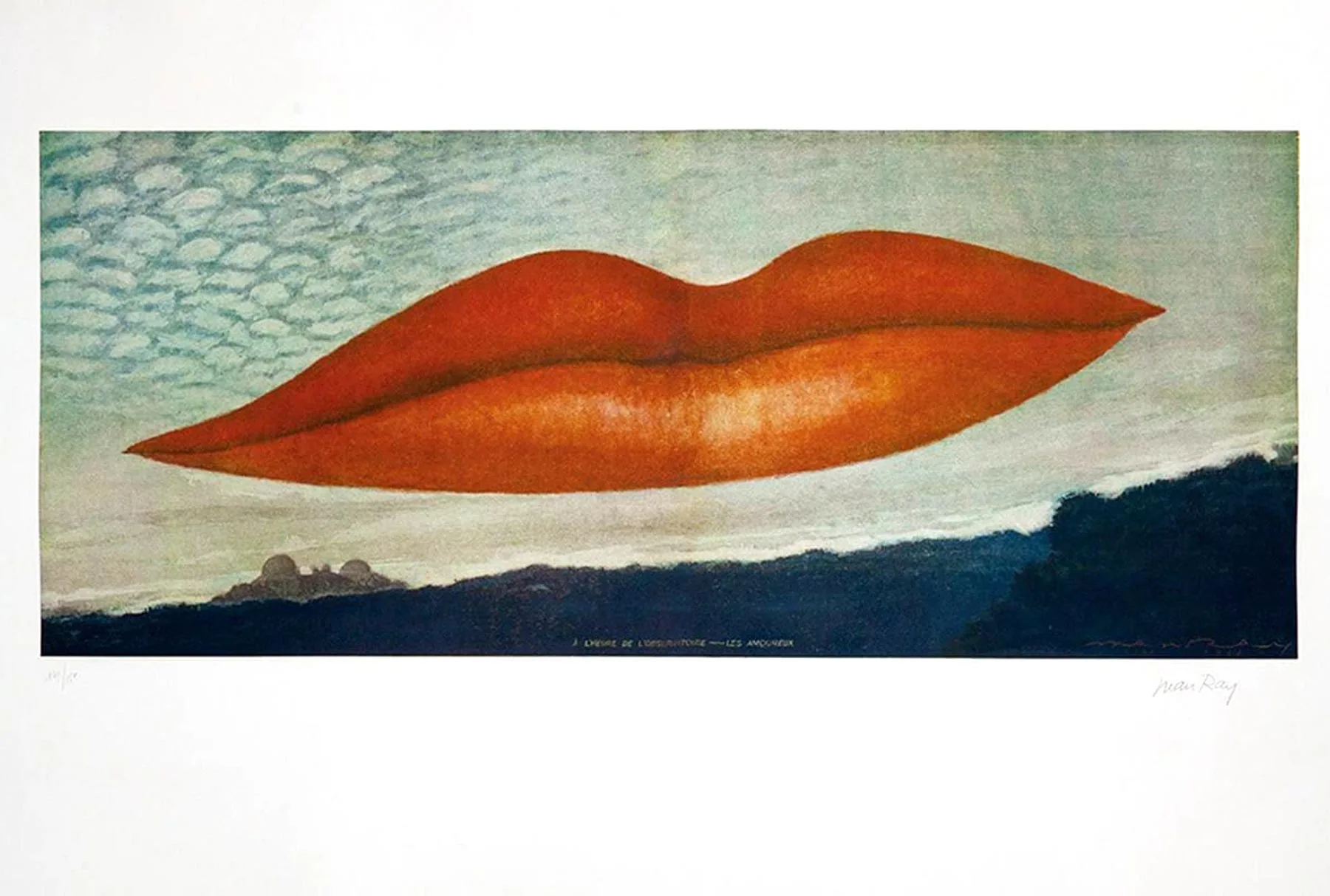
Painting was never abandoned, as the canvases shown in the great Surrealist exhibitions from the 1930s onwards attest. Among them is the celebrated À l’Heure de l’Observatoire, les Amoureux (1932–1934), in which Lee Miller’s crimson lips float, enormous, in the sky above the Paris Observatory: the torment of separation turned into a cosmic vision.
Man Ray’s prints answer his wish to spread his work as widely as possible, setting aside the notions of uniqueness and the original, which for him seemed to lose their meaning. The question feels urgent again today, when technology is reopening what a work of art is and who signs it: the rayographs were photographs made without a camera, and the artist remade his own objects forty years later without seeing any loss.
His objects of affection, ready-mades transformed by the artist’s hand, embody this attitude. Cadeau (Gift), the flat iron with nails fixed to its base, was born on 3 December 1921, the opening day of Man Ray’s first Paris solo show at Philippe Soupault’s Librairie Six: the original disappeared that same day, and the artist remade it several times from 1963. Indestructible Object (1931), a metronome with Lee Miller’s eye, which became Object to Be Destroyed when their relationship ended, was likewise conceived to be replicated, manipulated and revised. Painting and design meet in Palettable, a palette-shaped table designed in 1941 and produced in 1971, and in the Monument to the Unknown Painter (1955). Andy Warhol, who knew him in his final years, turned him into an icon.
Surrealism, cinema and Italy
The exhibition also documents key moments in the history of the avant-garde: Résurrection des Mannequins records one of the most fascinating rooms of the 1938 International Surrealist Exhibition at the Galerie Beaux-Arts in Paris, where artists including Dalí, Ernst, Miró, Duchamp and Man Ray himself dressed female mannequins in one of the most legendary installations of the twentieth century. His rare but significant films, landmarks of avant-garde cinema, are on view too, along with particular attention to Man Ray’s close relationship with Italy in the 1960s and 1970s.
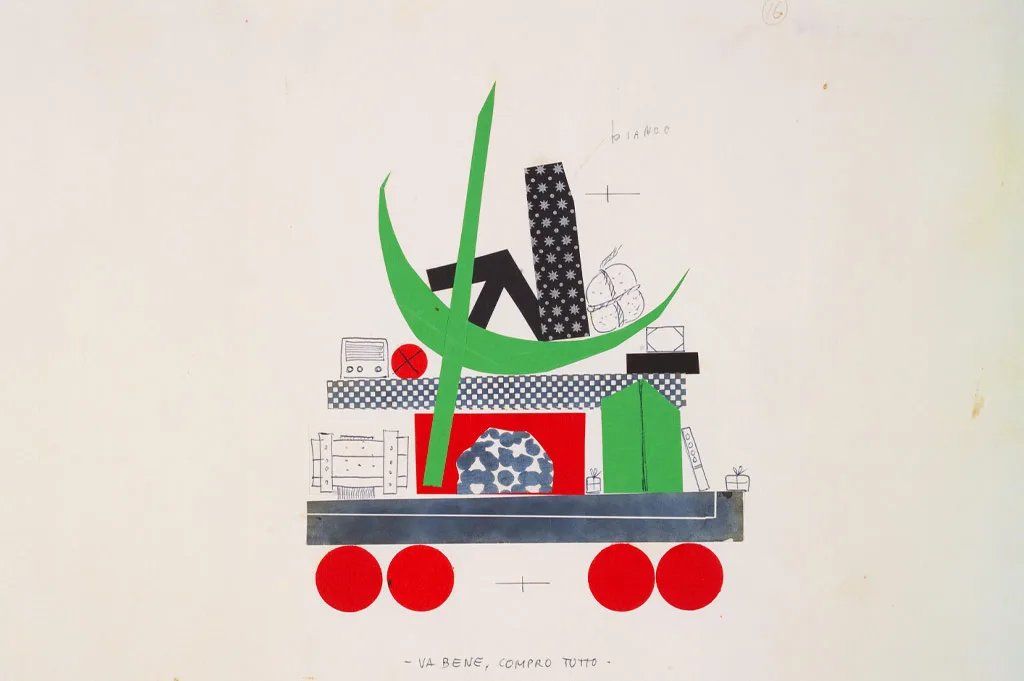
The exhibition draws on loans from major museums, renowned galleries and private collections in Italy and abroad, and is curated by Walter Guadagnini, Mauro Carrera and Stefano Roffi. Over the years the Villa dei Capolavori has devoted major exhibitions to figures who shared the avant-garde stage with Man Ray, from Miró to de Chirico, from Cocteau to Warhol, from Surrealism to Munari: Man Ray: tutto brings those paths together in the artist who crossed them all. The full catalogue, with essays by the curators and leading scholars, is published by Dario Cimorelli Editore.
Visiting the exhibition
Where: Fondazione Magnani-Rocca, Villa dei Capolavori, Via Fondazione Magnani-Rocca 4, Mamiano di Traversetolo (Parma), Italy
When: 12 September – 13 December 2026
Opening hours: Tuesday to Friday 10am–6pm (ticket office closes at 5pm); Saturdays, Sundays and public holidays 10am–7pm (ticket office closes at 6pm). Closed on Mondays; open on Monday 7 December, 1 November and 8 December.
Tickets: €15 full price, also valid for the permanent collection, the Romantic Park and the Villa’s Secret Cabinets; €13 groups (at least 15 people); €5 schools and under 14. Tickets are bought on arrival; booking is not needed for fewer than 15 people.
Guided tours (in Italian): Saturdays at 4pm; Sundays and public holidays at 11.30am, 3.30pm and 4.30pm. €20 including admission. Booking: [email protected]
Information: [email protected], tel. +39 0521 848327
Frequently asked questions
When can I visit Man Ray: tutto?
From 12 September to 13 December 2026, at the Villa dei Capolavori in Mamiano di Traversetolo, near Parma, Italy.
How many works are on display?
Over 300 works: photographs, paintings, objects, sculptures, prints, books and films. It is the most complete retrospective ever devoted to Man Ray in Italy.
What are the opening hours?
Tuesday to Friday, 10am to 6pm (ticket office closes at 5pm); Saturdays, Sundays and public holidays, 10am to 7pm (ticket office closes at 6pm). Closed on Mondays, except Monday 7 December. Open on 1 November and 8 December.
How much is the ticket?
€15 full price, also valid for the permanent collection, the Romantic Park and the Villa’s Secret Cabinets. €13 for groups of at least 15 people, €5 for schools and children under 14.
Do I need to book?
No booking is needed for fewer than 15 people: tickets are bought on arrival. Tickets are not sold online.
Are there guided tours?
Yes, in Italian: Saturdays at 4pm, Sundays and public holidays at 11.30am, 3.30pm and 4.30pm. €20 including admission. Book by email at [email protected] or join at the entrance while places last.
Who curated the exhibition?
Walter Guadagnini, Mauro Carrera and Stefano Roffi. The catalogue is published by Dario Cimorelli Editore.
Can I also see the permanent collection?
Yes: the exhibition ticket includes Luigi Magnani’s collection, with works by Titian, Dürer, Van Dyck, Goya, Canova, Monet, de Chirico, Morandi and many others.
How do I get to the Villa dei Capolavori from Parma?
The Fondazione Magnani-Rocca is at Via Fondazione Magnani-Rocca 4, Mamiano di Traversetolo, about 20 minutes by car from Parma. Directions: how to get here (in Italian).