The exhibition ended on 30 June 2024.
In short. Bruno Munari (Milan, 1907–1998) was an artist, designer, graphic designer and author for children: from the Macchine inutili (Useless Machines) to the Libri illeggibili (Illegible Books), from children’s workshops to the Compasso d’Oro awards. Pierre Restany called him the Leonardo and the Peter Pan of Italian design. In 2024 the Magnani-Rocca Foundation dedicated the exhibition Bruno Munari. Tutto (“Everything”) to him, with about 250 works.
Now at the Villa dei Capolavori: Man Ray: tutto, until 13 December 2026. The permanent collection and the Romantic Park can be visited throughout the opening season: opening hours and tickets.
Bruno Munari
16 March – 30 June 2024
Magnani-Rocca Foundation, Mamiano di Traversetolo – Parma
At the Magnani-Rocca Foundation, the largest Italian exhibition on one of the most iconic figures of twentieth-century design and visual communication – BRUNO MUNARI – staged after the memorable exhibitions at the Rotonda della Besana (2007) in Milan and the Ara Pacis (2008) in Rome.
In the celebrated Villa dei Capolavori, home of the Magnani-Rocca Foundation at Mamiano di Traversetolo near Parma, a few steps from the rooms housing major works by Titian, Dürer, Van Dyck, Goya, Canova, Renoir, Monet, Cézanne, de Chirico, Morandi, Burri and many others, from 16 March to 30 June 2024 one of the greatest creative geniuses of the twentieth century is celebrated: the “inventor” Bruno Munari (Milan 1907–1998), whom Pierre Restany called the Leonardo and the Peter Pan of Italian design.

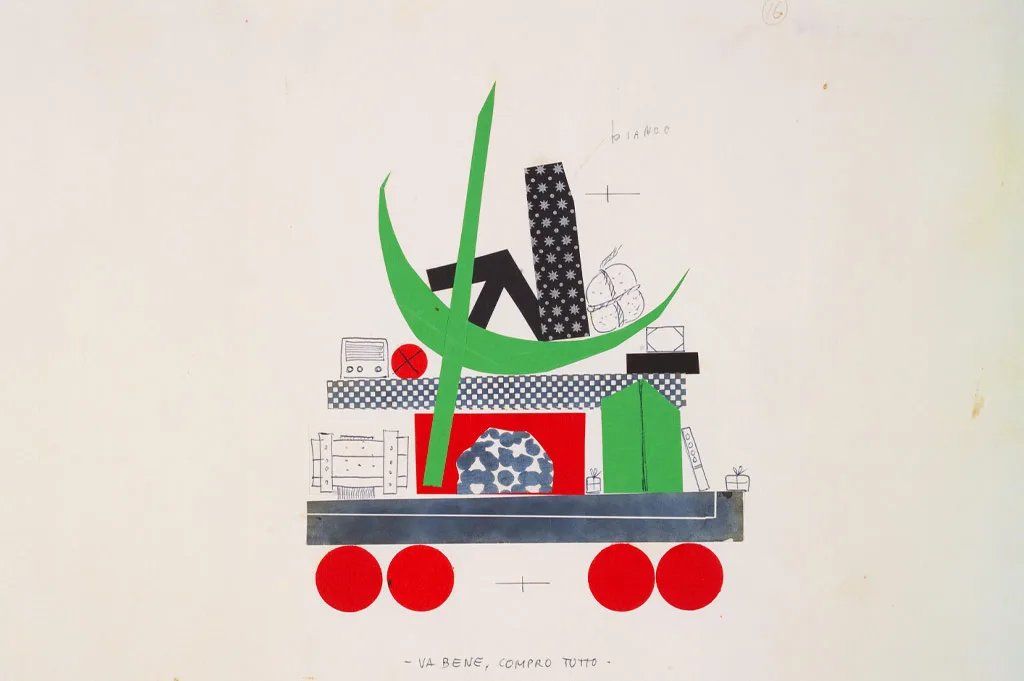
The exhibition brings together seventy years of ideas and work – Munari began his career during the so-called Second Futurism, around 1927 – across every field of creativity, from art to design, from graphics to pedagogy. Because it is hard to separate clearly the linguistic territories he worked in over time, the exhibition will not be divided by type or chronology, but by attitudes and concepts, so as to show the connections and design relationships between objects that may seem very different from one another.
Graphics, objects, works of art: TUTTO (“everything”) answers to a design method that became more precise over the years, with his major courses at American universities and with his most ambitious project, the workshops to stimulate children’s creativity, which since 1977 have remained at the forefront of pre-school and early-school education.


In recent years Munari’s work has received renewed attention, at last on the international stage as well, following the recognition he earned in his lifetime, above all in countries such as Japan, the United States, France, Switzerland and Germany, as well as, of course, Italy.
“Munari,” explains Marco Meneguzzo, a distinguished Munari scholar and the curator of the exhibition, “is a very current figure in today’s liquid society, in which there are no limits between expressive territories. He is an example of flexibility, of human beings’ capacity to adapt to their environment. His method consists in discovering the limit of the things around us and in wanting to overcome it every time.”
A rich catalogue, with an essay by the curator Meneguzzo (together with Stefano Roffi, scientific director of the Magnani-Rocca Foundation), previously unpublished critical contributions focused on individual “case studies” by the most important Munari scholars, and the publication of all the approximately 250 works on show, will be published by Dario Cimorelli Editore.

Magnani-Rocca Foundation, via Fondazione Magnani-Rocca 4, Mamiano di Traversetolo (Parma).
From 16 March to 30 June 2024. Opening hours: Tuesday to Friday, continuous 10:00–18:00 (ticket office closes at 17:00) – Saturdays, Sundays and public holidays, continuous 10:00–19:00 (ticket office closes at 18:00). Also open on 25 April, 1 May and 2 June. Closed on Mondays, open on Easter Monday.
Admission: €14, also valid for the Permanent Collections and the Romantic Park – €12 for groups of at least fifteen people – €5 for schools and children under fourteen. The ticket also includes free access to the Villa’s “Armadi segreti” (secret cabinets).
Groups of fewer than fifteen people do not need to book; tickets are bought on arrival at the Foundation. Information and group bookings: tel. +39 0521 848327 / 848148 [email protected] www.magnanirocca.it
On Saturdays at 16:30 and on Sundays and public holidays at 11:30, 16:00 and 17:00, there is a visit to the “Munari” exhibition with a specialist guide; you can book at [email protected], or come to the museum entrance until places run out; cost €19 (admission and guide).
Exhibition and catalogue (Dario Cimorelli Editore) curated by Marco Meneguzzo and Stefano Roffi, with a substantial essay by Marco Meneguzzo and thematic texts by Pierpaolo Antonello, Mauro Carrera, Cristina Casero, Alessandro Castiglioni, Marzia and Maurizio Corraini, Elena Dellapiana, Ali Filippini, Beppe Finessi, Gabriele Gimmelli, Walter Guadagnini, Steven Guarnaccia, Fernando Miglietta, Enrico Morteo, Andrea Piccardo, Stefano Roffi, Alberto Saibene, Silvana Sperati, Aldo Tanchis, Luca Zaffarano, Riccardo Zelatore.
Press office: Studio ESSECI Sergio Campagnolo
Contact: Simone Raddi [email protected] tel. 049 663499.
Press kit and images: www.studioesseci.net
The exhibition was made possible thanks to the contribution of:
FONDAZIONE CARIPARMA, CRÉDIT AGRICOLE ITALIA
Media partners: Gazzetta di Parma, Kreativehouse.
With the collaboration of: AXA XL Insurance and Aon, Angeli Cornici, Bstrò, Cavazzoni Associati, Società per la Mobilità e il Trasporto Pubblico.
Frequently asked questions
What is Bruno Munari famous for?
For working across every field of creativity: the Macchine inutili (Useless Machines, from 1933), the Libri illeggibili (Illegible Books, from 1949), the Negativi-positivi (Negative-Positives), design objects such as the Cubo ashtray and the Falkland lamp, the graphics for Campari (page in Italian) and children’s books. He received the Compasso d’Oro in 1954, 1955 and 1979, and the lifetime achievement award in 1995.
What is the Munari method based on?
On the idea that creativity is learned by doing. In 1977 Munari opened the first children’s workshop in a museum, at the Pinacoteca di Brera: children experiment with techniques and materials by playing, instead of copying models. His books Fantasia (1977) and Da cosa nasce cosa (1981; “One Thing Leads to Another”) explain his design method.
What is Bruno Munari’s philosophy?
For Munari, art and design have no boundaries: an object, a book or a game arise from the same method. According to the curator Marco Meneguzzo, his method consists in discovering the limit of things and in wanting to overcome it every time.
Did Bruno Munari have children?
Munari married Dilma Carnevali in 1934. His son Alberto chairs the Associazione Bruno Munari.
What was the exhibition Bruno Munari. Tutto at the Villa dei Capolavori like?
It was held from 16 March to 30 June 2024, curated by Marco Meneguzzo and Stefano Roffi: about 250 works arranged by attitudes and concepts, not by type or chronology. It is the largest Italian exhibition on Munari after those at the Rotonda della Besana (2007) and the Ara Pacis (2008).