In short. Giorgio de Chirico (Volos, 1888 – Rome, 1978) is the painter of Metaphysical art: deserted squares, long shadows, statues and mannequins that make the familiar enigmatic. One of his canvases from 1914, The Enigma of Departure, is in Luigi Magnani’s collection at the Villa dei Capolavori.
Although he is considered one of the most important Italian painters, Giorgio de Chirico was not born in Italy but in Volos, in Thessaly. Greece and the classical world would play a fundamental role in the artist’s imagination.
The painter studied at the Athens Polytechnic, the Academy of Fine Arts in Florence and the Academy of Fine Arts in Munich. He then moved to Milan in 1909 and to Paris in 1911, where his brother Alberto was already living.
The two brothers had not received a traditional schooling, partly because of their somewhat nomadic life and partly because of the cosmopolitan environment in which they had grown up: they were born in Greece to a noble Italian-speaking family. The breadth of their interests itself predisposed them to a wholly independent and original creative and intellectual path.
The metaphysical vision of the world was conceived and developed by Giorgio and Alberto de Chirico during the most important period of their intellectual and creative collaboration, between the summer of 1909 and the beginning of January 1911, in Milan and Florence. The term “metaphysics” goes back to Aristotle and means “beyond physics”, that is, beyond visible things. Today the term indicates an art movement founded by Giorgio de Chirico and Carlo Carrà in 1917, which seeks to represent what lies beyond physical appearance: the inner essence of reality, beyond sensory experience.
According to de Chirico, Metaphysical art expresses the inner essence of reality, a reality that is interpreted rather than described, even when it appears to take naturalistic forms. De Chirico inaugurated Metaphysical painting as early as 1909, the year in which Futurism was born.
While Futurism exalts dynamism and speed, in Metaphysical art everything is motionless and time seems to have stopped. Futurism seeks to renew visual language, whereas Metaphysical art brings perspective back.
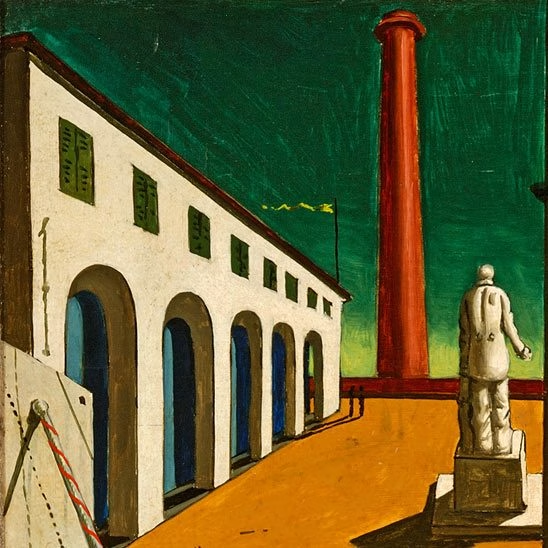
The enigmatic scenes in de Chirico’s works astonish precisely because of the apparent simplicity of what they depict: a reality that resembles the real one only in appearance. But a series of elements sets them apart from naturalism: the light is unreal and creates unusually long shadows, and the sky always has unnatural tints. Perspective, which seems to define a real space, is always distorted, so that space appears unstable. The urban scenes, the artist’s favourite subject in his Metaphysical works, look empty, lifeless and very silent. At the centre stands a classical statue, a foreign element that heightens the metaphysical quality of the whole.
De Chirico was probably influenced by the “metaphysical” aspect of the classical ruins he had observed during his childhood in Greece. Those fragments of architecture and statues had lost all meaning and became enigmatic objects. Giorgio de Chirico was not, however, a traditionalist painter: he admired Nietzsche’s philosophy and the idea that art should evoke a world that cannot be perceived by the senses.
This conception is the basis of his most important cycle, the “Piazze d’Italia” (Italian Squares), a series begun in 1910 and taken up again in his last years. These paintings contain all the elements of the metaphysical language: from exaggerated perspective to porticoes with round arches, from classical statues to long shadows, not forgetting the unreal atmosphere and the total sense of solitude.
Officially, Metaphysical painting was born in Ferrara from de Chirico’s meeting with Carrà. De Chirico considered Ferrara “the most metaphysical of all cities” because of its large squares with monuments casting long shadows, its perfect geometric symmetry, and the unnatural solitude of streets and squares overlooked by disused noble palaces, as in a dead city, as if the inhabitants had mysteriously vanished.
De Chirico’s masterpiece, “The Enigma of Departure” (dated 1914 by the artist), is already a fully metaphysical work, beginning with the title, in which some of the most significant terms of de Chirico’s theory recur: the enigma, the mystery that reading the philosophers had taught him to perceive behind the most ordinary appearances, and the departure, the mythical moment par excellence, the one that turns a man into a hero, an explorer of the unknown.
In “The Enigma of Departure” we find the Nietzschean symbols of the sail and the sea, metaphors for the adventures of the mind and for a journey of the spirit among the enigmas of existence, as well as a reference to the Greek sea. It is no coincidence that Nietzsche’s last “madness notes”, sent from Turin, were among de Chirico’s and Savinio’s favourite literary themes. The porticoes on the left are a memory of Turin; the sculpture of a bourgeois seen from behind has taken the place of the figure of the ancient philosopher in the earlier paintings, in a new symbol that can be traced back to the father figure. In this painting, as in others, we find a typical chimney of the Parisian suburbs.
Fragments of Bergsonian memories converge in the painting: besides the Greek, Turinese, Parisian and paternal presences, the crate in the left-hand corner refers to the artist’s many moves and journeys. The shadow cast by a figure we do not see heightens the atmosphere of estranging unease in the scene, accentuated by the tormented relationship between the interior of the house on the right and the exterior. From the dark black of the interior, one passes to the liberating opening of the sail onto the sea, where the mind frees itself in a journey.
Author: Matilde Volpi
The canvas is held in Luigi Magnani’s collection: read the page on the work The Enigma of Departure and find out how to see it in person at the Villa dei Capolavori.